RISCover.
Differential CPU Fuzz Testing.
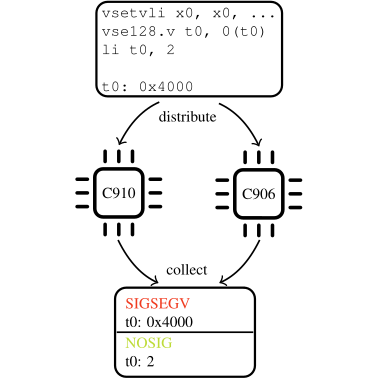
We discovered GhostWrite by analyzing both documented and undocumented instructions using a method called differential fuzz-testing for CPUs. The concept is intuitive: generate small programs, run them on different CPUs, and compare the results. Since every RISC-V CPU should follow the RISC-V specification, they should produce the same results for the same inputs. When results differ between CPUs, it suggests that one of the CPUs might have an issue.
For this, we developed a dedicated fuzzer called RISCover. Using RISCover, we identified GhostWrite when the T-Head XuanTie C910 CPU showed unusual behavior with an illegally-encoded vector-store instruction. While other CPUs generated page fault exceptions or refused to execute the instruction, the C910 executed it.
Upon deeper investigation, we discovered that this illegally-encoded instruction allows a process to write directly to physical memory instead of virtual memory, exposing a severe security vulnerability. Our findings on GhostWrite and RISCover have been accepted for publication in the proceedings of ACM CCS 2025.